


Blog
AMD Ryzen AI 400 Desktop CPUs – What to Expect

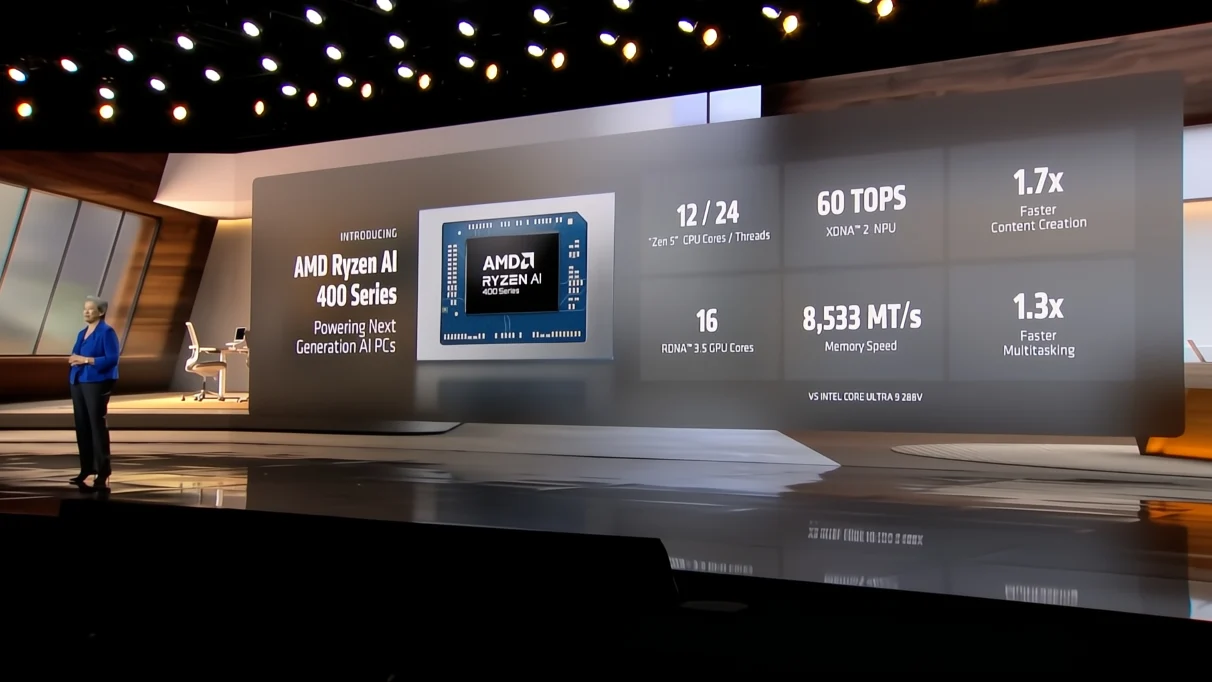
AMD Ryzen AI 400 Desktop CPUs: The Future of AI PCs for Gamers & Creators | Variety Infotech
Source: amd.com
When Your CPU Becomes Your AI Co-Pilot
A few years ago, a “powerful” desktop meant high core counts, a chunky GPU, and maybe some RGB to flex on your friends. Today, that definition is changing fast. The next wave of performance isn’t just about raw speed—it’s about intelligence. That’s where AMD’s Ryzen AI 400 desktop CPUs come in, turning your processor into a kind of always-on AI co-pilot for everything you do, from gaming and editing to work and automation.
AMD has already launched Ryzen AI 400 in laptops with powerful NPUs (Neural Processing Units), and now the spotlight is shifting toward desktops. For PC builders, gamers, system integrators, and businesses in India, this is the moment to start planning for AI-ready rigs that run smarter, not just harder.
How We Got Here: AMD’s Journey to AI-First PCs
AMD didn’t jump into AI PCs overnight. Over the last few generations, they’ve steadily evolved the Ryzen lineup with stronger CPU cores, better integrated graphics, and deeper integration with AI workloads. Ryzen AI is the branding that ties all of this together: CPU + GPU + NPU working as a unified platform for on-device intelligence.
With Ryzen AI 400, that vision expands. These chips build on what AMD rolled out with Ryzen AI 300 series and earlier AI-enabled processors, adding more NPU performance (measured in TOPS), tighter integration with Windows AI features like Copilot+, and a clear roadmap toward “AI everywhere”—from thin laptops to full-blown desktops.
What Exactly Is Ryzen AI 400?
Think of Ryzen AI 400 as AMD’s first truly AI-first generation for client PCs. Instead of treating AI as a bonus feature tacked onto the CPU or GPU, it’s baked into the core design through three main engines on one chip:
- Zen-based CPU cores for traditional compute workloads like games, code, rendering, and multitasking.
- RDNA-based Radeon integrated graphics for visuals, encoding, light gaming, and GPU-accelerated tasks.
- A dedicated NPU built on AMD XDNA for ultra-efficient AI inference and background intelligence.
This tri-engine approach allows your desktop to run AI tasks continuously and quietly in the background while leaving CPU and GPU performance free for the things you actually feel—higher FPS, smoother timelines, snappier apps.
Laptop First, Desktop Next: AMD’s Strategic Play
If you’ve noticed Ryzen AI 400 branding mostly on laptops so far, that’s not an accident. AMD’s first rollout focuses on Copilot+ PCs, thin-and-light notebooks, and high-end mobile systems, where NPU power and battery life matter most.
From there, AMD’s roadmap clearly shows AI tech moving into desktop territory. Press briefings around CES 2026 confirm that Ryzen AI 400 platforms are shipping in systems now, and desktop-class parts are slated to follow, including the first Copilot+ desktop CPU from AMD.
For desktop users, that means:
- OEM and prebuilt AI desktops appear first.
- Retail boxed desktop CPUs follow once motherboards, BIOS, and software are fully tuned.
- AM5 becomes the long-term home for AI-ready Ryzen processors, so early adopters on AM5 get an easier upgrade path.
Under the Hood: Architecture and Core Technologies
Zen CPU Cores: Classic Muscle, Next-Gen Brains
Ryzen AI 400 desktop CPUs are expected to use the latest Zen generation, continuing AMD’s trend of higher IPC, better efficiency, and strong multi-core scaling.
What that means in real life:
- Faster single-core performance for games and lightly-threaded apps.
- More cores/threads for editing, streaming, compiling, and running VMs.
- Better performance per watt, which also helps with thermals in tighter cases.
RDNA Radeon Integrated Graphics: Not Just a Fallback
If you’ve ever built a budget system or office PC, you know integrated graphics matter. AMD has typically led this segment, and Ryzen AI 400 is expected to continue the pattern with RDNA-based iGPUs capable of:
- Smooth everyday workloads and media playback.
- Light to moderate gaming without a dedicated GPU.
- Hardware acceleration for video encoding, decoding, and some AI tasks.
For many business or home PCs, that means you can launch with just the APU and upgrade to a discrete GPU later.
The NPU: Your Silent AI Worker
The NPU is the star of the Ryzen AI story. AMD’s XDNA-based NPUs are designed specifically for AI and machine learning inference, with Ryzen AI 400 platforms delivering around 60 TOPS of NPU compute in mobile configurations, and similar-class NPUs are expected when desktop parts arrive.
Key advantages of the NPU over CPU/GPU for AI workloads:
- Much lower power draw for continuous tasks.
- Ability to run in the background without hitting your FPS or render times.
- Tuned latency and performance for on-device AI assistants, vision models, and audio processing.
In practice, your PC can run AI tools constantly—transcribing, enhancing, filtering, predicting—without feeling like “something is slowing down.”
What the NPU Actually Does on a Desktop
Many users logically ask: “Why do I need AI on a desktop when I already have a powerful CPU and GPU?” The answer: efficiency, privacy, and smarter workflows.
Everyday Quality-of-Life Boosts
- AI-powered search, summaries, and recall in Windows through Copilot-style features.
- Automatic background noise suppression in calls.
- Voice recognition and dictation that feels fast enough to actually use.
All of this can run on the NPU so your CPU stays free.
Creative Workflows Get an Upgrade
If you’re a creator, editor, or designer, Ryzen AI 400 will feel like a hidden assistant:
- AI upscaling and enhancement for videos and photos.
- Automatic background removal and smart selections in design tools.
- Real-time filters and effects for streaming and conferencing.
Paired with a discrete GPU from Variety Infotech’s graphics card collection, this lets you run GPU-heavy workloads and still lean on the NPU for helper tasks.
Business & Productivity: Automation Without the Cloud
For businesses and power users:
- On-device analysis of documents and data.
- AI-powered security, anomaly detection, and risk analysis.
- Task automation that doesn’t need to ping a remote server every second.
Because the NPU executes locally, sensitive data never has to leave the machine, which is especially crucial in finance, legal, healthcare, or enterprise IT use cases.
Local AI = Better Privacy and Response Time
Running AI locally on the NPU means:
- Less cloud dependence for personal data.
- Lower latency for interactive features like chatbots or voice assistants.
- Predictable performance that doesn’t depend on internet speed or server load.
For many users in India where connectivity can fluctuate, this is a big win.
AM5 Platform: The Home for Ryzen AI Desktops
AM5 Socket, DDR5, and PCIe 5.0
Ryzen AI 400 desktop CPUs are expected to drop into the AM5 socket, the same platform already used by Ryzen 7000 and newer processors.
That gives you:
- DDR5 memory support for higher bandwidth and lower latency.
- PCIe Gen 5 for next-gen GPUs and ultra-fast NVMe SSDs.
- A long-term upgrade path, so you’re not stuck replacing your board again soon.
You can start browsing AM5 motherboards right now in the Variety Infotech AMD motherboard section to get your platform ready.
BIOS Updates and AI-Optimized Chipsets
Motherboard brands will roll out BIOS updates to support the new Ryzen AI 400 desktop chips and their NPUs. Over time, expect chipsets and firmware to:
- Offer better NPU monitoring and controls.
- Integrate with Windows features and AMD software for AI management.
- Provide tuned profiles for AI-heavy workloads vs gaming vs low-power modes.
Early AI desktops will likely be sold as OEM prebuilts first, giving AMD and partners a chance to validate platforms before boxed CPUs hit DIY shelves.
OEM First, Builders Later: How Ryzen AI Hits the Market
AMD and its partners have already announced that Ryzen AI 400 platforms are shipping in OEM systems starting Q1 2026, with professional and AI-focused devices leading the charge.
For desktops, the rollout is expected to look like this:
- Phase 1: OEM & prebuilt AI desktops – systems from brands like Dell, HP, Lenovo, Acer, ASUS, and others featuring Ryzen AI platforms, probably tuned for Copilot+ and business use.
- Phase 2: Retail boxed desktop CPUs – Ryzen AI desktop parts for enthusiasts, system integrators, and DIY builders, with SKUs likely mapping to familiar Ryzen 5 / Ryzen 7 / Ryzen 9 tiers.
As of now, there are:
- No confirmed boxed desktop Ryzen AI 400 SKUs by name.
- No official retail pricing for desktop variants.
- No final per-model core counts published for socketed desktop versions yet.
But AMD has explicitly stated that desktop Ryzen AI is part of the roadmap and that Ryzen AI desktops are expected to follow mobile parts shortly after.
Gaming on Ryzen AI 400 Desktops: Why Gamers Should Care
It’s easy to assume “AI CPUs” are just for office machines or data science nerds—but gamers stand to gain a lot.
Better CPU Headroom and Background Control
Because AI tasks are handled by the NPU, your CPU cores are less likely to get bogged down with background processes and effects. That can translate into:
- More stable FPS in CPU-sensitive games.
- Fewer micro-stutters when streaming, recording, or running overlays.
- Smoother multitasking while gaming (chat apps, browsers, monitoring tools).
AI-Assisted Visuals and Game Tools
With developers increasingly integrating AI into games and tools, you can expect:
- AI-powered upscaling, denoising, and post-processing enhancements.
- Smarter game assistants, bots, or difficulty tuning.
- AI-accelerated content creation for game clips and highlights.
Pair a future Ryzen AI 400 desktop CPU with a modern GPU from our graphics card category, and you get a platform that’s ready both for today’s engines and tomorrow’s AI-heavy game features.
Who Should Care About Ryzen AI 400 Desktops?
1. AI Enthusiasts and Early Adopters
If you love experimenting with local LLMs, image generators, automation workflows, and self-hosted tools, a Ryzen AI 400 desktop is basically your playground. The NPU becomes a dedicated accelerator you can target through AI frameworks and AMD’s ROCm stack.
2. Content Creators and Streamers
Editors, designers, 3D artists, and streamers benefit from:
- AI upscaling and enhancement tools.
- Smart masking, tracking, and effects in NLEs and design apps.
- Background AI processes that won’t nuke render or export times.
Combine a Ryzen AI CPU with a fast SSD and DDR5 from Variety Infotech’s components section, and you get a seriously future-proof creator rig.
3. Businesses and Professional Users
If your organization is betting on Copilot, automation, or AI-powered analytics, AI desktop CPUs help you:
- Keep sensitive data on local machines.
- Reduce cloud-related latency and costs.
- Build standardized, AI-ready workstations for teams.
4. System Integrators and PC Retailers
If you build systems for customers (like what you’re doing with Variety Infotech), Ryzen AI 400 desktops open a whole new category:
- “AI-ready office PCs” for business clients.
- “AI creator builds” bundled with AI software.
- “Next-gen gaming builds” marketed as Copilot+ or AI-enhanced rigs.
Building an AI-Ready Desktop Today: How to Prepare
Even if boxed Ryzen AI 400 desktop CPUs aren’t on shelves yet, you can start preparing your builds and catalog.
Step 1: Commit to AM5 as Your Base
Pick AM5 boards from trusted brands in our AMD motherboard category and begin standardizing on them for mid–high tier builds
Benefits:
- Easy future upgrades to Ryzen AI desktop CPUs.
- DDR5 and PCIe 5.0 already in place.
- Broad compatibility with current Ryzen 7000 and future AI SKUs.
Step 2: Choose Ryzen CPUs with a Mind Toward Upgrade
Right now, you can stock and sell current-gen Ryzen AM5 CPUs while highlighting that the platform is “AI-ready” for the next wave of Ryzen AI 400 desktop processors.
Explore our AMD processor catalog
Step 3: Position Your Builds as AI-Ready, Not Just Gaming-Ready
In your product descriptions and landing pages:
- Emphasize AM5, DDR5, and future Ryzen AI potential.
- Highlight compatibility with upcoming AI desktops and Copilot+ class features.
- Mention AI workflows (video, office, automation) in addition to FPS numbers.
This aligns with AMD’s own messaging around “AI everywhere” and cloud-to-client AI scaling via ROCm and NPUs.
Retail Reality Check: What We Know and Don’t Know Yet
As of early 2026, the situation looks like this:
- ✅ Ryzen AI 400 platforms are announced and shipping in client and OEM systems.
- ✅ OEM desktops and Copilot+ PCs based on Ryzen AI are scheduled in waves through 2026.
- ❌ Retail boxed Ryzen AI 400 desktop CPU SKUs (with exact names and pricing) are not yet fully disclosed.
- ❌ Final desktop-only specs (core counts, GPU CU counts, NPU TOPS for each SKU) have not all been published.
However, AMD and multiple independent reports confirm that desktop Ryzen AI CPUs are on the roadmap, with desktop systems expected to follow mobile parts, including at least one Copilot+ desktop-class CPU.
Verdict: Why Ryzen AI 400 Desktops Are Worth Watching
Verdict: Ryzen AI 400 Desktop CPUs are more than just another generational bump—they’re the turning point where desktop CPUs become intelligent, context-aware partners in your workflow, not just brute-force engines.
For gamers, that means smoother multitasking and AI-enhanced visuals. For creators, it means faster automation and smarter tools. For businesses, it means local, private AI that doesn’t depend on always-on cloud access. And for system builders like Variety Infotech, it opens up a whole new category of AI-ready desktops built on the AM5 ecosystem.
Retail may still be catching up, but now is the perfect time to:
- Standardize on AM5.
- Stock modern Ryzen and Radeon hardware.
- Position your store as the go-to destination for AI-ready gaming and productivity PCs in India.
If you’re planning your next upgrade or product lineup, keep an eye on Ryzen AI 400 desktops—and start building the foundation today with processors, motherboards, and GPUs from the Variety Infotech PC components section.